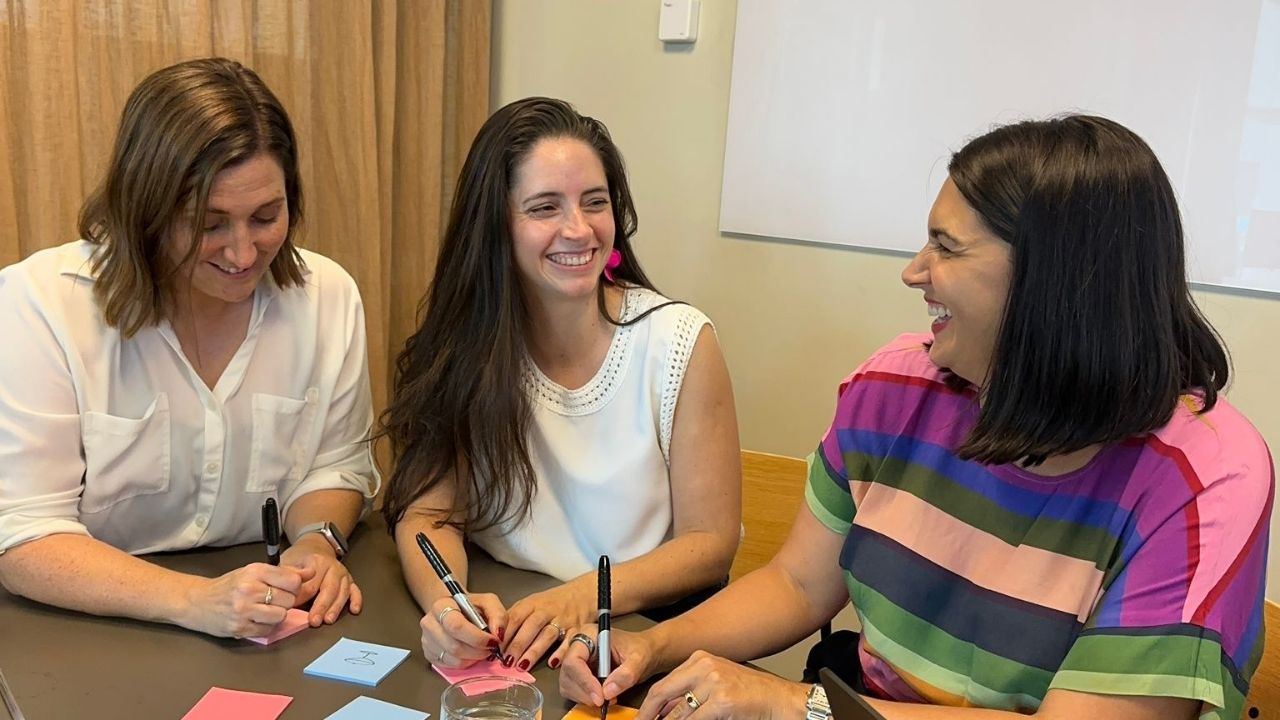
Twenty business owners and non-for-profit leaders are walking into a room with me this week. They each came with their own goals. One wants to retain clients and untangle her systems. Another wants to expand reach and sharpen his financial positioning. A speech pathologist wants to stop being the ceiling of her own clinic. A few want low-cost or no-cost marketing ideas that actually work for an organisation their size.
Different businesses. Different sectors. Different problems.
And yet the room they are all walking into has been designed as if there is one thing underneath all of them. Because there is.
Most frameworks expect you to fit the mould. This one builds the mould around you.
Before I built the agenda for this session, I asked everyone to tell me what they actually wanted to walk away with; and to give me a snapshot of where they are right now in their experience design. Same as I would do if I was designing a new service for a client. Understanding who you are designing for is the most important step to creating something people will actually use and get results from. So that is where I started.
The responses were illuminating.
One person said she wanted to identify the top two or three things she could actually implement, not a list of twenty possibilities. Two or three she could commit to and move on.
Another wanted practical tools and systems that would reduce her team’s workload; not more software to learn, something that would genuinely make the work lighter.
One wanted to think about structure and partnership; not just tactics, but how to position his organisation for longer-term sustainability and reach.
Several wanted new ways to promote their business with little or no budget. Which sounds like a marketing question, but is actually an experience design question, as we will get to.
And then there was the speech pathologist. Largely running her clinic alone right now; clinical work, parent communication, admin, systems, quality, all of it. She wanted to think about how to build a team that can carry the vision without her being in every room. How to move from doing everything to building something.
When I read that one, I felt it. That is not a systems problem. That is a clarity problem. And clarity about the experience you are trying to create is always the thing that makes everything else possible.
“Understanding who is in the room before you design anything is not a nice-to-have. It is the difference between a session people leave energised and one they leave politely.”
The five movements
The session has a clear structure, even when it does not feel like one from the inside.
First, we see the whole ecosystem. Most businesses and organisations have more than one user, and this step helps people see why it matters to consider and design for all of them. For the speech pathologist, the ecosystem is not just the child. It is the parents, the referring GP, the grandparents who have strong opinions, the other allied health professionals involved. What drives each of them? What stops each of them? What would make it easier for them to say yes, stay, or refer someone else?
Second, we map what already exists. Before anyone talks about what to do differently, we look honestly at the current experience; for the people at the centre of each business. Where is it strong? Where does it get inconsistent? Where does it quietly fall apart? Most people have never looked at their own business this way, as an end-to-end experience rather than a set of separate functions. That first look changes the conversation.
We map step by step what the people you serve actually do; from before they even think about you, to the moment they leave. It surprises me every time how many people find this challenging. We are so used to thinking about what we do that we forget to think about what they experience. Those are not the same thing.
Third, we improve and simplify. Once we can see the experience clearly, we work out where to strengthen it. Not from a list of best practices, because a best practice for one might be the worst practice for someone else. We get specific; into what this particular business, this particular community, this particular person actually needs.
This is also where the low-cost marketing question gets answered. Because the most powerful thing you can do to promote your business is make the experience worth talking about. Referrals, especially in allied health and community services, are built on experience. Not advertising. Not social media strategy. Experience.
Fourth, we get practical. Systems, processes, tools, people. What specifically needs to change? What is the simplest version of that change that would hold in a real organisation with real constraints? For some people this will be an onboarding sequence. For others, a communication rhythm. For the speech pathologist, it might be an experience vision clear enough that another clinician could carry it without her needing to be in every room.
Fifth, we plan. A 90-day plan, not a wish list. The goal is not to generate twenty actions. It is to find the two or three that, done well, would move everything else. We sequence it on a now / next / later basis, so people can start the following day rather than wait until everything is perfectly aligned.
A workshop is an experience too
Here is the thing I want people to understand about why I design the room before I walk into it.
Every single choice I make about the sequence, the questions, the structure, is in service of the people in that room leaving with more clarity than they arrived with; and a plan they actually believe in.
Not a plan that sounds good in a workshop and falls apart on a Tuesday. A plan that reflects how their business actually works, what their team can carry, and what their clients or members actually need.
The design of the room is in service of that. The sequence of the session is in service of that. The questions I ask are in service of that.
Because a workshop is an experience. And experience, designed well, changes things.
This is exactly the same discipline I bring to working with clients on their customer experience. You start by understanding who you are designing for. You look honestly at what already exists. You find where to strengthen and simplify. You get specific about what actually needs to change. And then you plan for what is real, not what is ideal.
The order matters. The intention behind the order matters just as much.
Purpose without experience design is just a poster.