Last week I watched a video that I haven't been able to stop thinking about.
A woman's car broke down in regional Australia at 10pm. She was alone. She called roadside assistance and was told someone would arrive in 120 minutes.
Twenty minutes later, a car with a cracked window pulled up beside her.
The driver aggressively told her to open her door. She asked for identification. He said his name and his company. She asked again, calmly. He shouted back: “F* you, you’ll have to wait for the guys from Canberra.”
Her sister, who was on the phone with her, called the police. She called the roadside assistance company to verify his identity.
It took the company 22 minutes to confirm whether their own contractor was who he said he was.
Their official response to the whole situation: we are not required to provide our contractors with identification.
That response is where my mind completely blew.
The idea that came from it
She is now campaigning for roadside assistance companies to implement a simple code system, similar to the one Uber Eats uses when a delivery arrives at your door. You get a code. The driver has the code. Trust established in seconds.
The company’s response to her campaign? She’s only one person. That’s not enough.
Her idea is brilliant. A simple code gives peace of mind to someone in a genuinely vulnerable position, and it is almost certainly low cost to implement. The barrier is not technical. It is a choice; to care about the experience their customers are having, or not.
Three things this story reveals about experience design
1. The law sets a floor, not a standard.
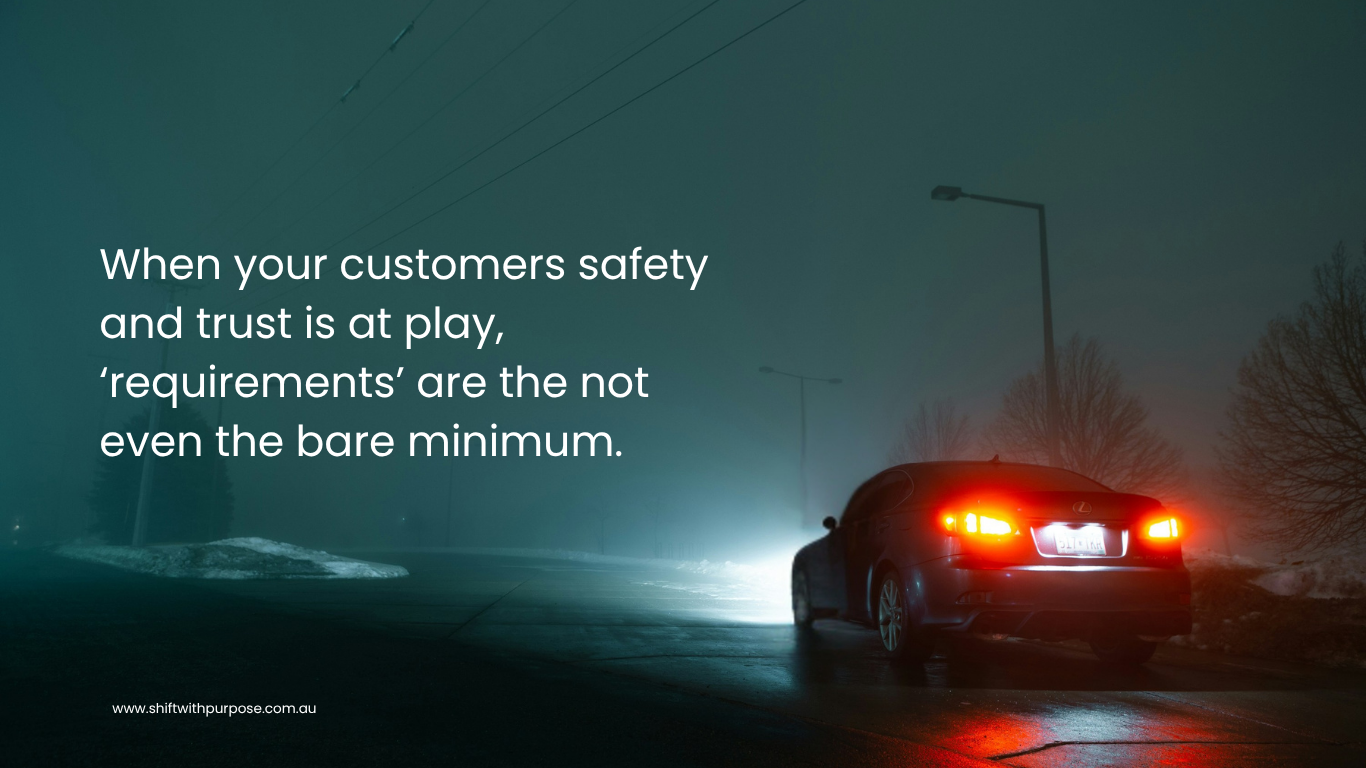
“Not required” is not the same as “not responsible.” If your customer’s safety, trust, and peace of mind is at stake, you should care anyway; not because a regulation tells you to, but because that is what it means to actually stand behind your brand.
In every organisation I work with, the most dangerous phrase I hear is some version of this: we’re compliant. Compliance is the minimum. The experience your customers have lives in everything above it. The floor is where you avoid penalties. The standard is where you build trust, impact, and legacy.
This is especially true in purpose-led organisations, where the gap between stated values and lived experience is visible to everyone. You don’t get to say you care about people and then point to the fine print when something goes wrong.
“You don’t get to say you care about people and then point to the fine print when something goes wrong.”
2. The people who represent you when you’re not there are still your brand.
A contractor shouting aggressively at a woman alone on a dark road at 10pm is not a contractor problem. It is a brand problem, a values problem, and a long-term sustainability problem. You cannot separate the two.
If your service is delivered by contractors, franchisees, frontline team members, or anyone who isn’t directly employed and managed by you, the experience they deliver is still your experience. The customer doesn’t distinguish between the company and the person representing it. They just remember how it felt.
This is one of the most common gaps I find in organisations doing genuinely good work: the experience at the front line doesn’t match the values on the wall. Not because the people don’t care, but because nobody has deliberately designed what the experience should feel like, or made sure the people delivering it have the tools, the training, and the clarity to deliver it consistently.
3. The best solutions are almost always simple.
A code. That’s it. The same system Uber Eats uses for a burrito is the system that could have made that woman feel safe at 10pm on a dark road in regional Australia.
This is what I mean when I say that experience design is not about expensive technology or complex transformation programs. It is about asking: what does this moment feel like for the person living it? And then designing that moment deliberately, with the human at the centre.
The solution was obvious. Someone just had to care enough to look for it.
Two questions worth sitting with
Where are you not required to do something, but doing it would make a significant difference to the people you serve? Take the Customer Experience Quiz to see where your client journey is quietly leaking trust, impact, and referrals.
If you work with contractors or frontline team members: how are you making sure the experience they deliver is consistent with your values, consistent across clients, and not just whatever they feel like on the day?
These questions seem rhetorical. They are not. They are a version of the question I start with in almost every engagement I take on.
What you can do right now
Sign the petition to require roadside assistance companies to implement a code system for their contractors. It takes 30 seconds.
Forward this to someone who should read it; a friend who drives alone at night, a colleague who manages contractors, a leader who thinks “not required” is a good enough answer.
And if either of those questions above resonated with you, I’d love to have a conversation about what could look different for your customers and your team. Book a discovery call.
Purpose without experience design is just a poster.
Catalina Bonavia is the founder of SHiFT with Purpose, a human-centred experience design consultancy working with purpose-led organisations across Australia.