Over fourteen weeks we build one new revenue stream; from first idea to market test. You leave with the evidence, the business case, and the equipment to take it forward.
Using the value you are already generating, the IP you already own.
We find the opportunity, choose it deliberately, design the offer, cost it, price it, build the things you need to sell and deliver it, and then put it in front of real buyers before we finish.
Not a strategy you implement later. Not a workshop with sticky notes. A new offer, tested, with the evidence to back your next decision.
Your next revenue stream might already be inside your organisation.
Somewhere along the way this sector accepted a trade: you can be mission-driven or you can be commercially confident; and choosing both makes you suspicious.
I don’t accept it. And neither do the leaders I work with.
Funders matter. They are not the enemy and they should be part of your strategy.
But when a single funding round can redraw everything you’ve built, you’re not running a strategy. You’re renting one.
And when the landlord decides to move on, the whole thing goes with them.
You are already creating value that you give away for free, while working hard to raise more funds.
So before we add anything, I look at what you already have.
And yes, you’re probably wondering what value I’m actually talking about.
The training you built. The assessment tool. The methodology. The service a corporate would happily pay for. The relationships, the expertise, the data, the trust.
None of that is a new business. It may be the business you already have, sold to someone who is not the person you currently serve. The work we do is about finding a different customer who has a problem your organisation is uniquely equipped to solve.
An offer is something your organisation can repeatedly provide to a defined customer in exchange for money. It might be:
What would you do with another quarter of a million a year that nobody can switch off?
Run fewer events; let your people focus on the mission.
Start working through the waitlist instead of managing it.
Raise the quality and depth of support for the people you serve.
With the ability to actually forecast. And a service that grows rather than resets each year.
What any single offer earns depends on the market, the product, and the effort behind it. What we control is whether it is designed to be worth building in the first place; and we screen for that at every step.
We understand the organisation as it actually is today; your current model, customers, capabilities, assets, unmet needs, constraints and readiness. We find what’s already working, what’s getting in the way, and where there might be something worth building.
A sharp diagnosis of what’s holding you back from your next chapter, and an initial desirability, feasibility and viability analysis. Not sixty pages that end up in a drawer.
We look for the value hiding in plain sight. What do you know? What do you have? What do people need? Where could value be created? And, crucially, who would pay for it? We develop three possible futures; not three variations of the same safe idea.
Your Opportunity Map and the Three Futures.
Now we make the decision. Each opportunity is tested against impact, demand, income, capability and feasibility. We look at who else is serving this need, what they charge, what they’re missing, and whether you can credibly do it better. One opportunity gets backed; because it has the strongest case for investment.
One prioritised opportunity and the reasoning a board can follow. This is often the moment you see something you couldn’t see before.
Now we make it real. The offer, the customer, the value proposition, the delivery model, the pricing, the unit economics, the capability required, and the assets that make it sellable and deliverable.
The offer, built; plus the business case for taking it forward.
We put the smallest useful version of the offer in front of real buyers. A paid pilot, a pre-sale, a prototype, a customer commitment, or another test designed to generate the strongest possible evidence.
Real market evidence; not opinions about whether the idea is good.
The final two weeks turn evidence into a decision and a practical next move, plus a 90-day roadmap built around the reality of your team, your systems and your constraints.
A clear path to putting your new offer into your customers’ hands. No wishful thinking; no “now someone needs to implement the strategy.”
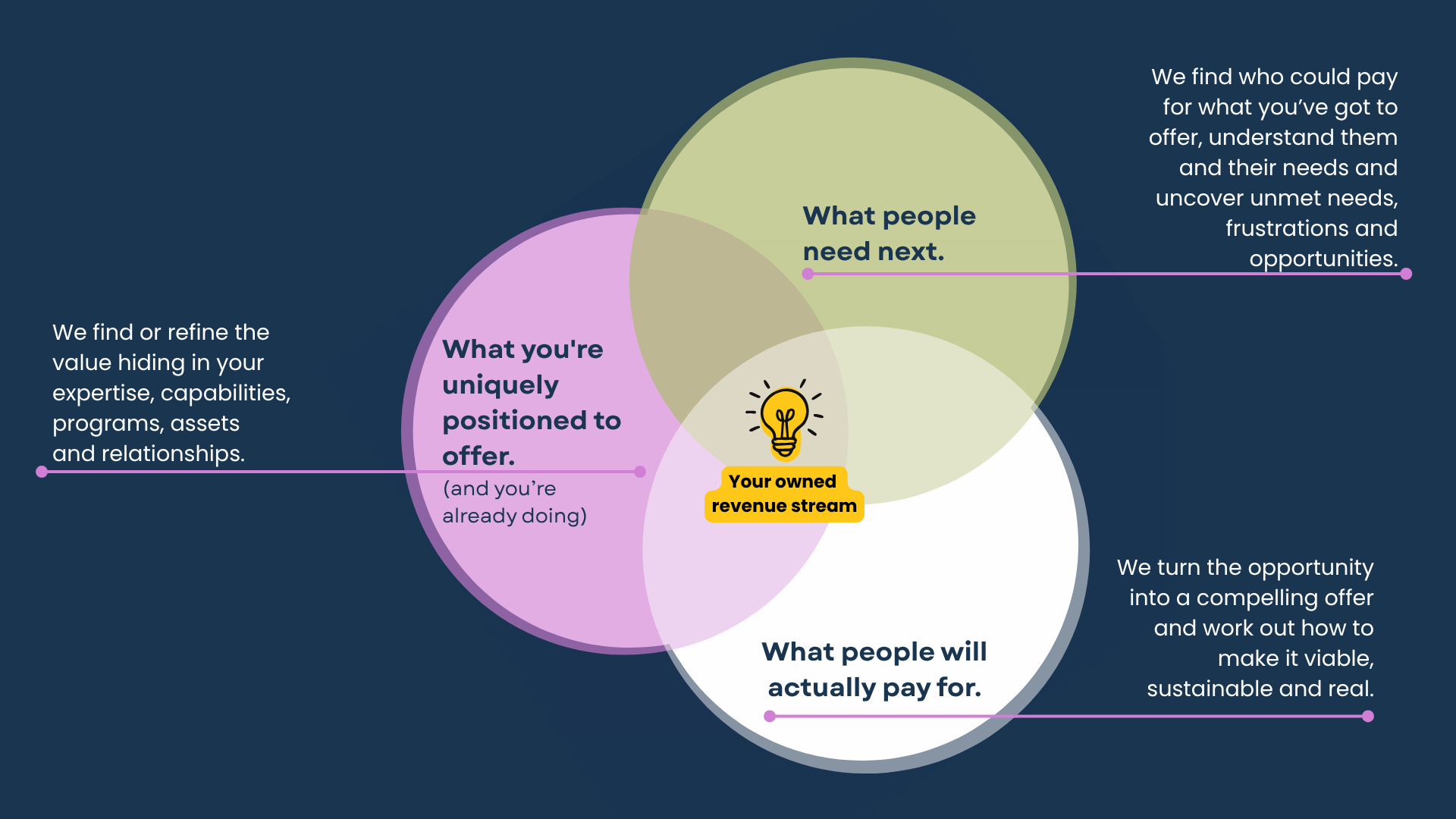
We match what the market needs with your values and your capability. That intersection is where a competitive advantage actually lives; and why the offer we build is hard for anyone else to copy.
Take something you already do and offer it to a new audience, or in a new way.
Turn existing expertise, methodology or IP into something repeatable and scalable.
Build something genuinely new from an emerging or unmet need.
We develop three, deliberately. The first idea in the room is rarely the best one.
People saying they like an idea isn’t evidence that they’ll buy it. So we don’t confuse interest with demand.
The Evidence Ladder
The goal isn’t Level 4 every time. It’s to reach the strongest evidence we can realistically get before you invest further.
You’re not looking for a room full of exciting ideas. You’re looking for evidence you can act on. So we test before you invest.
The evidence supports launching. You have what you need to start.
There’s something here; it needs adjustment before it’s worth investing further.
The evidence says don’t invest further. You just saved yourself the money, time and goodwill; and you still hold the Opportunity Map with two futures on it.
You have no spare capacity. A project that adds to your team’s workload is a project that quietly dies in week six.
So the split is written into the scope before we start.
Market ready means you could start selling it the week after we finish.
Three viable pathways from the Opportunity Map; scored and ranked, so a no on one isn’t a dead end.
Designed, costed, priced, and put in front of real buyers.
Board or funder ready; with the numbers, the risks, and the ask.
The specific assets required to sell and deliver it; pricing model, sales kit, offer prototype, delivery playbook, or customer onboarding. We decide which four matter most once we know what we’re building.
Exactly what happens next; built for the reality of your team, your systems and your constraints.
No sixty-page report. No “someone needs to implement this now.”
I’m an industrial designer who ended up in the purpose-led world and never left. Fourteen years, hundreds of founders and leaders, and a career spent moving between the frontline and the boardroom.
Along the way I learned to read a P&L, design services, develop new concepts, lead change, work with boards, facilitate hard decisions, and turn ideas into things people can actually use.
Most people in this space either think or make. I do both; which is why what gets designed is built for the reality of the organisation that has to deliver it.
Your CFO helps you understand the numbers, strengthen the financial strategy, and work out what the organisation needs to stay viable. They help you understand where the money needs to come from.
I work on the other side of the equation: what could you actually sell? I help you design what you can offer to bring more of it in. If you already have a CFO, I want them in the room. If you don’t, we can proceed. If you want one, I can recommend trusted partners.
This isn’t priced by the day or the hour. You’re investing in the opportunity, the evidence and the equipment required to take it forward.
First conversation is free and commits you to nothing.
A first conversation costs nothing and commits you to nothing. Bring the challenges, the ideas, the things you’ve tried; and the thing you can’t quite name yet. We’ll work out together whether there’s something here worth building.
If I don’t think the Revenue Lab is right for your organisation, I’ll tell you; and I’ll tell you what I’d do instead.
What’s happening, what’s getting in the way, and what you’re seeing that others aren’t.
Scope, capped hours, investment, and exactly what we’re building together.
Fourteen weeks later you have an evidence-backed, market-tested offer and a clear decision about what happens next.
If the timing isn’t right; join the 2027 waitlist. You’ll be first to hear when the next round opens; and first to hear about the group program for organisations earlier in the journey.
Join the 2027 waitlist